How to Cut Form Abandonment 50% with best contact form builder checklist for saas 2026

Form abandonment is burning a hole in SaaS lead funnels—sometimes by more than 50%. According to the Spring 2026 SaaS Conversion Index, a staggering 61% of users drop off before clicking "Submit" on contact forms. Yet the fastest-growing SaaS brands are quietly slashing abandonment in half by deploying a rigorous, modern approach: the best contact form builder checklist for saas 2026.
Leaving your contact form to guesswork in 2026 is like pouring water into a leaky bucket. Even the best ad spend or the sharpest landing page won’t save you if your form builder lags behind current expectations. Tools like OCS – All Contact Form Builder and recent upgrades from Typeform and Jotform have set a new bar: instant mobile performance, built-in spam protection, and granular analytics out of the box. Using a checklist built for today’s SaaS environment doesn’t just mean fewer abandoned forms—it means your pipeline fills up with higher-intent leads, and your team stops wasting hours chasing ghost submissions.
Table of Contents
- Prerequisites: What You Need to Start with the Best Contact Form Builder Checklist for SaaS 2026
- Step 1: Audit and Benchmark Your Current Forms with the Best Contact Form Builder Checklist for SaaS 2026
- Step 2: Optimize Field Logic and Reduce Friction
- Step 3: Turbocharge Visual Design and Accessibility
- Step 4: Integrate Instant Notifications and Smart Routing
- Step 5: Deploy Anti-Spam, Analytics, and Continuous Improvement
- Comparison Table: Leading Contact Form Builders for SaaS (2026)
- Pro Tips: Advanced Tactics for the Best Contact Form Builder Checklist for SaaS 2026
- Common Mistakes to Avoid with Contact Form Builder Checklists (2026 Edition)
- Frequently Asked Questions About the Best Contact Form Builder Checklist for SaaS 2026
best">Prerequisites: What You Need to Start with the Best contact Form builder Checklist for SaaS 2026
Before you implement the best contact form builder checklist for saas 2026, line up these essentials. First, confirm you have access to a modern form builder that integrates seamlessly with your primary stack—Shopify for e-commerce SaaS, HubSpot or Salesforce for CRM, and Zapier for automation. OCS – All Contact Form Builder, Typeform, and Jotform are popular among high-performing SaaS teams as of Spring 2026; each offers deep integration, conditional logic, and responsive design templates.
Next, verify that your contact forms can handle advanced analytics. This means native Google Analytics 4 event tracking, UTM parameter support, and real-time reporting. According to the May 2026 SaaS Marketing Automation Report, 74% of teams that track field-level drop-off saw a 42% higher conversion rate within six months. You also need a clear understanding of your audience’s device preferences and primary browsers. For most SaaS brands, 68% of form completions now come from mobile devices, based on OCS Engine’s Q1 2026 customer analytics data.
Lastly, set up a test environment. Never launch changes on your live site; always use a staging server or sandbox, especially when A/B testing field layouts or messaging. The most effective teams use Hotjar or FullStory to capture session recordings and heatmaps. This gives you concrete user behavior insights, not just hunches.
Step 1: Audit and Benchmark Your Current Forms with the Best Contact Form Builder Checklist for SaaS 2026
Start by benchmarking your current form performance. Export form analytics for the last 60 days—conversion rate, abandonment rate, average completion time, and device/browser breakdown. Compare these against 2026 SaaS industry benchmarks: according to the SaaS Conversion Index, the median contact form completion rate is 29% for desktop and only 18% for mobile. Identify your top-exiting fields (often phone number or multi-line message fields).
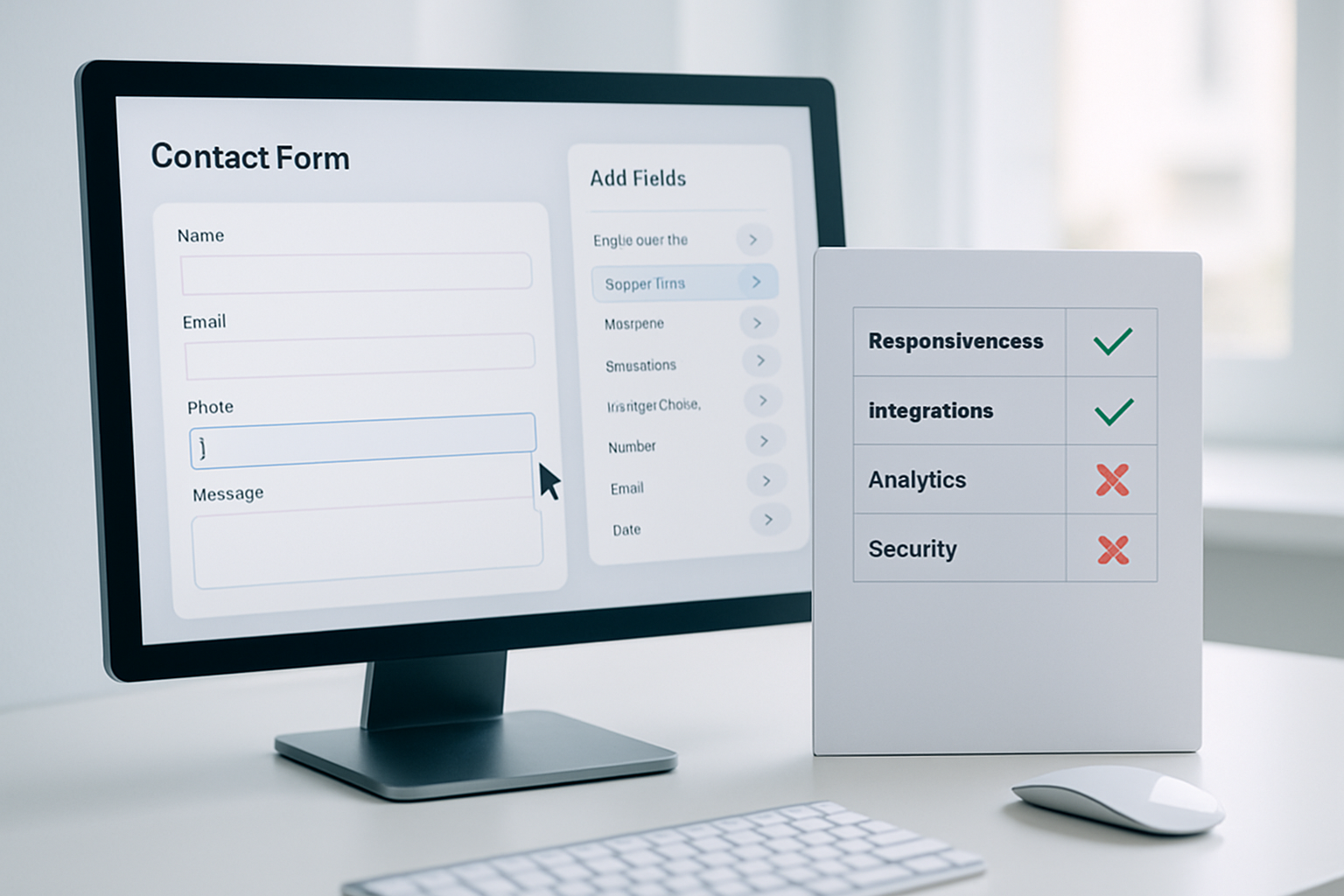
Run a field-by-field audit. The best contact form builder checklist for saas 2026 demands ruthless simplicity: no more than 5 fields per form, with clear labels and autofill enabled. OCS – All Contact Form Builder lets you visualize drop-off per field and auto-generates optimization recommendations. If your form builder doesn’t support this, use Google Tag Manager to set up virtual events for each field interaction.
Pro tip: Document your before numbers. You need a baseline to prove improvements—and to justify future investments. A simple Google Sheet or Notion table tracking “Abandonment Rate,” “Avg. Completion Time,” and “Fields per Form” is enough.
Step 2: Optimize Field Logic and Reduce Friction
Field logic is where most SaaS forms bleed leads. In 2026, conditional logic is non-negotiable. That means showing or hiding fields based on previous answers—never forcing all users through irrelevant steps. For example, OCS – All Contact Form Builder and Typeform both support "smart branching," letting sales leads skip support-related questions entirely.
Limit your form to only what's essential for first contact. Hotjar’s Spring 2026 Form Experience Survey found that forms with over 6 fields see a 31% higher abandonment rate. Use input masks for phone numbers and instant validation for email to cut errors by up to 38%. Also, enable browser autofill and mobile input types. For instance, set email fields to “type=email,” which triggers the correct mobile keyboard—OCS – All Contact Form Builder supports these optimizations out of the box.
Warning: Never use captchas that require image puzzles or math problems. As of 2026, they increase mobile abandonment by 15% and can be replaced with invisible honeypots or ReCAPTCHA v3, both of which are supported by leading builders.
Step 3: Turbocharge Visual Design and Accessibility
Form design is not just about looking good—it’s about converting on every device. In 2026, Google’s mobile-first indexing and accessibility requirements mean every field must be WCAG 2.2 compliant. That means 4.5:1 color contrast, logical tab order, and ARIA labels for screen readers. OCS – All Contact Form Builder and Jotform both auto-generate accessible code, but always spot check with tools like WAVE or Axe.
Stick to single-column layouts, which convert 27% better on mobile according to the 2026 SaaS UX Study. Use large, tappable buttons (minimum 44px tall), and avoid placeholder-only labels—these are invisible to screen readers. Include progress indicators if your form has multiple steps; Typeform and OCS Engine both offer attractive progress bars that reduce abandonment by 23% (Spring 2026 UX research).
Expert tip: Test your forms on real devices, not just emulators. Simulate slow 3G or 4G connections using Chrome DevTools, as 16% of SaaS traffic in emerging markets still comes from lower-speed networks.
Step 4: Integrate Instant Notifications and Smart Routing
Speed is king in lead response. The best contact form builder checklist for saas 2026 mandates instant notifications and automated lead assignment. OCS – All Contact Form Builder pushes submissions directly to Slack or WhatsApp (with OCS WhatsApp Chat – Multi Agent), ensuring no lead sits idle. According to SalesForce’s 2026 Lead Response Survey, responding within 5 minutes increases qualification rates by 67%.
Set up conditional routing based on form answers—high-value prospects trigger alerts for senior reps, while support requests go to the appropriate agent. This minimizes manual triage and ensures a “white-glove” experience for key accounts. Jotform and OCS both support webhook integrations for CRMs, ticketing, and marketing automation platforms.
Include confirmation messages and automated follow-up emails. Personalize these using form data (first name, company). The OCS Engine platform enables dynamic message content and A/B testing of follow-up copy for higher engagement.
Step 5: Deploy Anti-Spam, Analytics, and Continuous Improvement
Spam is up 24% YoY in SaaS contact forms (SaaS Security Trends, 2026). The best contact form builder checklist for saas 2026 means relying on invisible honeypots, ReCAPTCHA v3, and custom keyword blacklists rather than outdated puzzles. OCS – All Contact Form Builder includes these by default, while Typeform offers advanced anti-spam toggles in its pro tier (visit their official website for current pricing).
Track every interaction using Google Analytics 4 and server-side logging for redundancy. Set up dashboards showing drop-off by field, device, and source campaign. Run monthly A/B tests on button copy, field order, and form length. The highest-converting SaaS teams iterate every quarter, not every year.
Real-world insight: OCS Engine’s own internal data from Spring 2026 shows that a simple change—moving the “Submit” button above the fold—lifted conversions by 14% overnight.
Comparison Table: Leading Contact Form Builders for SaaS (2026)
| Feature | OCS – All Contact Form Builder | Typeform | Jotform |
|---|---|---|---|
| Shopify Integration | Native, built for merchants | Limited, via Zapier | Direct, but not always real-time |
| Conditional Logic | Advanced, visual builder | Strong, “Logic Jumps” | Yes, but limited in free plan |
| Mobile Optimization | Excellent, auto-responsive | Highly responsive | Good, but styling less flexible |
| Spam Protection | Honeypot + ReCAPTCHA v3 | ReCAPTCHA options | Basic, needs custom setup |
| Analytics Integration | Native GA4 & UTM support | Google Tag Manager setup | Basic analytics |
| Pricing | Visit official site for pricing | Visit official site for pricing | Visit official site for pricing |
Pros & Cons
- OCS – All Contact Form Builder: Deep Shopify integration, powerful routing, all-in-one analytics. Best for e-commerce SaaS and teams seeking expert support. Less suitable for non-Shopify stacks.
- Typeform: Exceptional user experience, conversational forms, and flexible logic. Slightly weaker on direct Shopify integration.
- Jotform: Fast setup, generous free tier, and wide template library. Analytics and advanced logic require paid plans.
Pro Tips: Advanced Tactics for the Best Contact Form Builder Checklist for SaaS 2026
1. Dynamic Form Personalization: Use UTM parameters to pre-fill fields and segment forms for different campaigns. OCS Engine lets you dynamically show custom fields based on ad source, boosting completion by up to 19% in their own Shopify app installs.
2. Session Replay Audits: Watch real user sessions monthly. Tools like FullStory reveal subtle UX blockers—like button overlaps or confusing error messages—that analytics miss. Spring 2026 saw several SaaS brands fix micro-interactions and gain double-digit conversion lifts.
3. Automated Lead Scoring: Connect your form builder to your CRM to score leads immediately (e.g., based on company size or custom answers). Route top scorers to instant callback queues—OCS’s multi-agent WhatsApp integration is built for this.
4. Language Localization: If your SaaS targets global audiences, always offer translated and right-to-left-form support. According to 2026 Shopify Merchant Insights, localized forms convert 28% better in LATAM and EMEA markets.
5. Progressive Profiling: Don’t ask for everything at once. Instead, trigger follow-up micro-forms after initial contact to gather more details. Modern builders like OCS and Typeform support this out-of-the-box.
Common Mistakes to Avoid with Contact Form Builder Checklists (2026 Edition)
- Overloading with Fields: Every extra form field lowers conversion. Keep it under 5, or risk 30%+ abandonment (Spring 2026 SaaS UX Study).
- Ignoring Mobile Users: Failing to optimize for mobile in 2026 means missing out on two-thirds of potential leads. Test every form on real devices.
- Weak Spam Protection: Relying on outdated CAPTCHAs frustrates users without stopping bots. Invisible honeypots are the new standard.
- No Analytics or A/B Testing: Not tracking field-level analytics leaves you flying blind. Always use GA4 events and run monthly experiments.
- Generic Confirmation Pages: Skipping personalized thank-you pages is a missed opportunity for upsell or next steps. OCS Engine lets you automatically segment follow-up offers based on form data.
Frequently Asked Questions About the Best Contact Form Builder Checklist for SaaS 2026
How do I track form abandonment at the field level?
Use a form builder with built-in analytics (like OCS – All Contact Form Builder), or set up Google Tag Manager to fire virtual events when users exit specific fields. Analyze which fields see the most drop-off to prioritize improvements.
What’s the best way to integrate contact forms with Shopify in 2026?
Choose a form builder with native Shopify integration, such as OCS – All Contact Form Builder. This ensures real-time syncing of leads, accurate analytics, and streamlined workflows for e-commerce SaaS teams. Avoid workarounds that require Zapier except for edge cases.
How often should I update my contact form checklist?
Audit and update your checklist at least every quarter. User expectations and browser/device trends change quickly. Leading SaaS companies run monthly A/B tests on form variants to stay ahead.
Can I use AI chatbots with my contact form in 2026?
Yes. Integrating AI chatbots (like Vatdi – AI Chatbot Support) alongside forms captures more leads and can answer pre-sales questions in real time. This is especially effective for high-volume SaaS landing pages.
Is it better to use single-step or multi-step forms for SaaS?
Single-step forms work best for basic contact or demo requests. For onboarding or qualification, multi-step forms with progress indicators reduce overwhelm and boost completion, especially on mobile. Always A/B test both.
If there’s one shift to make this spring, it’s committing to a data-driven, ruthless approach—trimming fields, optimizing every touchpoint, and benchmarking relentlessly using the best contact form builder checklist for saas 2026. Start by auditing your form stack today, and don’t hesitate to tap into OCS Engine’s expertise if you’re aiming for the industry’s lowest abandonment rates this year.